
A 100-city study of who AI recommends and what it cites, across Google AI Mode, Google AI Overviews, Gemini, ChatGPT, and Perplexity.
Optimize My Firm | Data collected October 2026.
Note: Please pay special attention below to “recommended” vs “cited”. Being cited rarely accomplishes anything of value. Our goal is to drive cases.
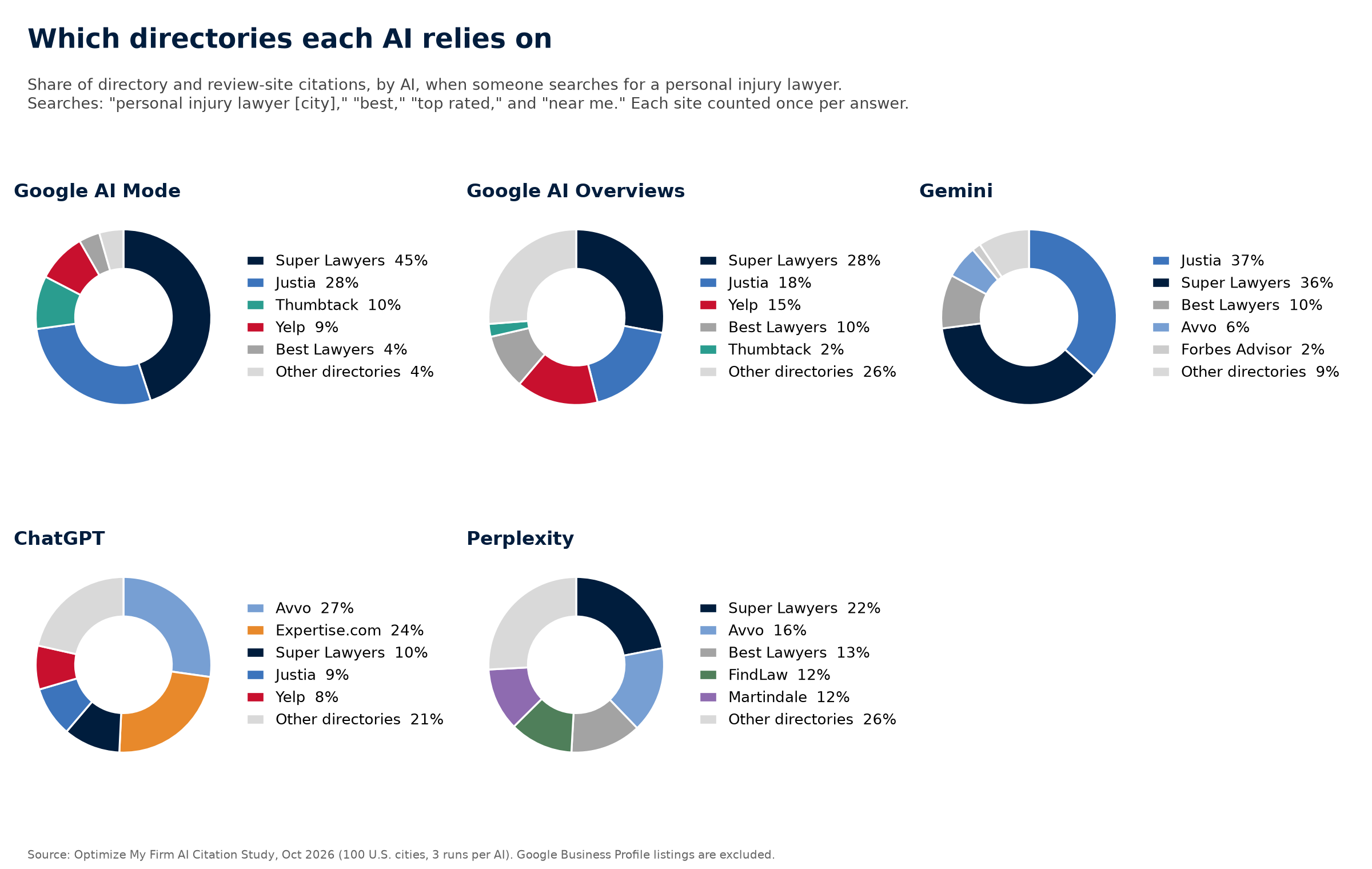
Here are the most important directories to claim and get reviews on, based on which ones each AI platform relies on when someone searches for a personal injury lawyer.
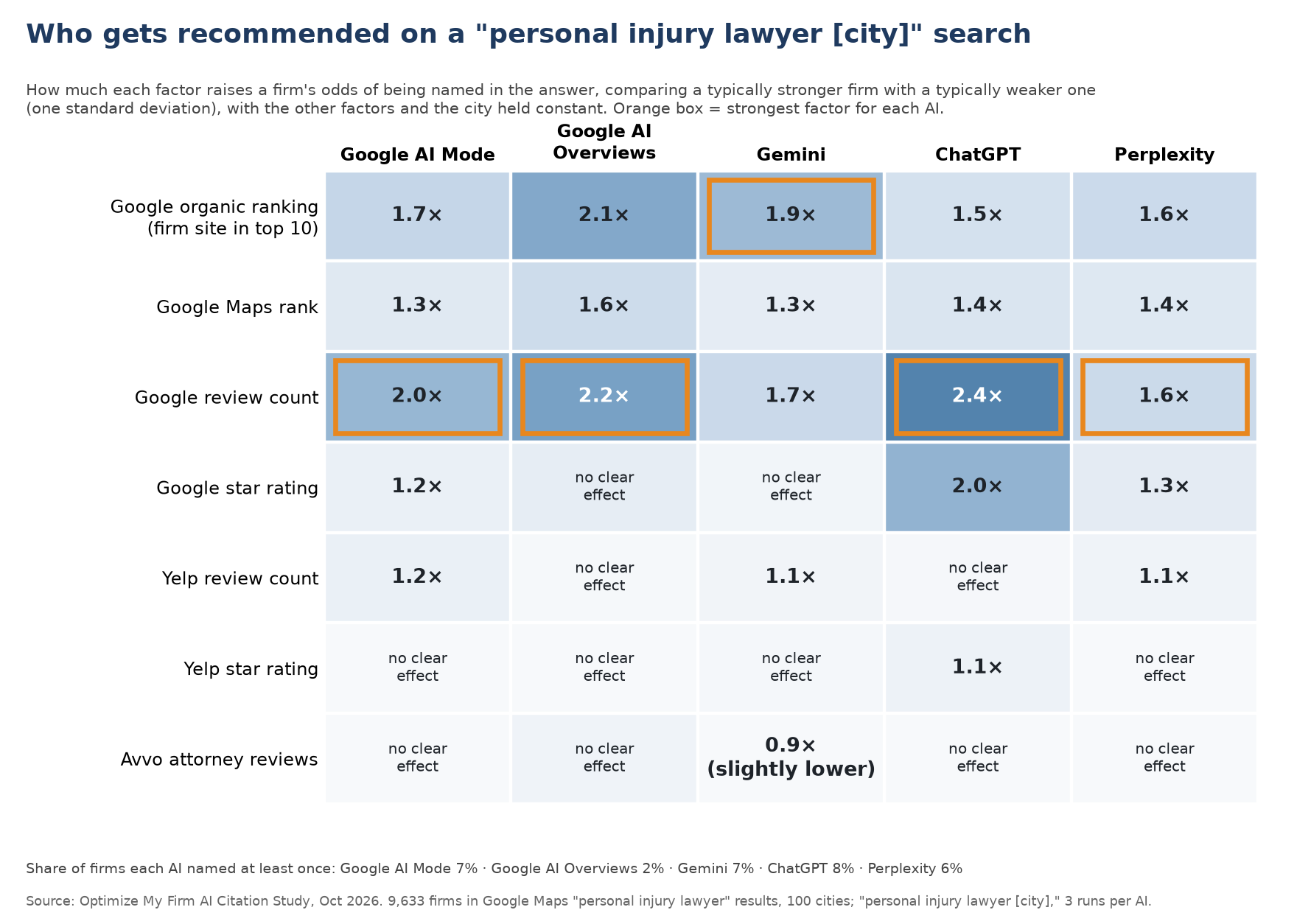
This section looks only at recommendations: which law firms each AI actually names, not which websites it links to. We ran “personal injury lawyer [city]” on all five engines in all 100 cities, three times each. Then we checked each of the 9,633 firms in each city’s Google Maps results to see whether it was named, and compared that with seven factors:
What matters most, by engine:
Avvo attorney reviews showed no clear effect on any engine.
| Firm group | Google AI Mode | Google AI Overviews | Gemini | ChatGPT | Perplexity |
|---|---|---|---|---|---|
| Firm site in organic top 10 | 30% named | 16% | 37% | 29% | 25% |
| Not in organic top 10 | 4% | 1% | 4% | 6% | 4% |
| Top 3 in Google Maps | 28% | 15% | 25% | 37% | 23% |
| Maps rank 11 or lower | 5% | 2% | 6% | 6% | 5% |
| 250+ Google reviews | 21% | 10% | 19% | 26% | 16% |
| Under 50 Google reviews | 3% | 1% | 4% | 3% | 3% |
| 10+ Yelp reviews | 21% | 5% | 17% | 18% | 15% |
| No Yelp reviews found | 6% | 2% | 7% | 7% | 5% |
Share of firms named at least once on “personal injury lawyer [city]” in their city.
What about Yelp? Firms with 10 or more Yelp reviews were named two to three times as often as firms with none. But those firms also tend to have more Google reviews and stronger rankings. Once those are accounted for, Yelp adds at most a small boost (1.1–1.2×), and for ChatGPT, Yelp review count showed no clear effect. Most personal injury firms have little Yelp presence: only 13% of firms in our data showed any Yelp reviews, with a median of 3 among those that did.
On this search, ChatGPT cited Yelp in only 6% of answers. Its most-cited platforms were Expertise.com (32%), Avvo (30%), and Justia (28%). Yelp was cited in 16% of Google AI Mode answers and 11% of AI Overviews.
The same pattern holds on “best,” “top rated,” and “near me” searches:
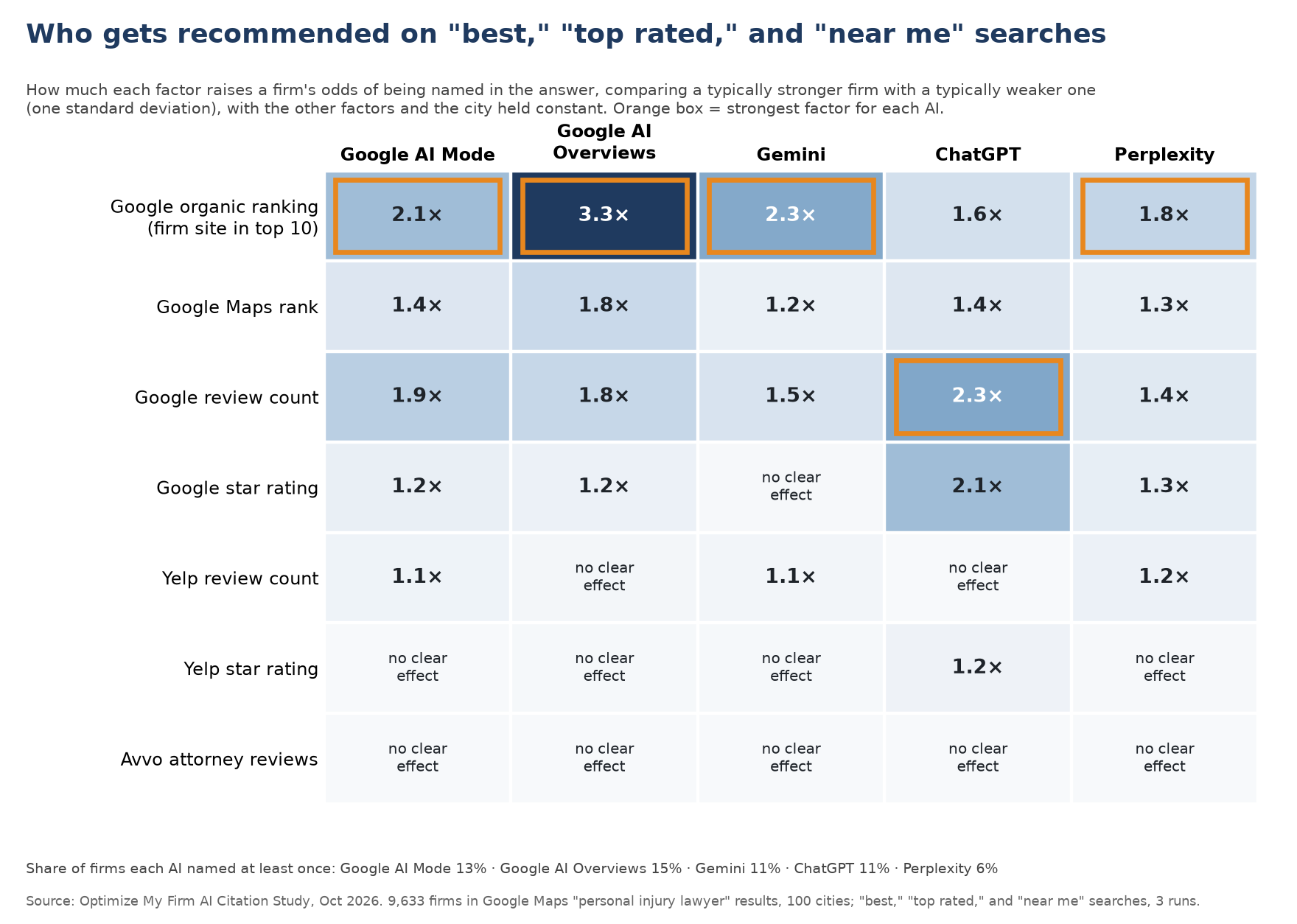
On those searches, organic ranking leads on four engines, and ChatGPT again leans most on Google review count and star rating. Yelp review count adds a small boost on Google AI Mode, Gemini, and Perplexity, and no clear effect on ChatGPT.
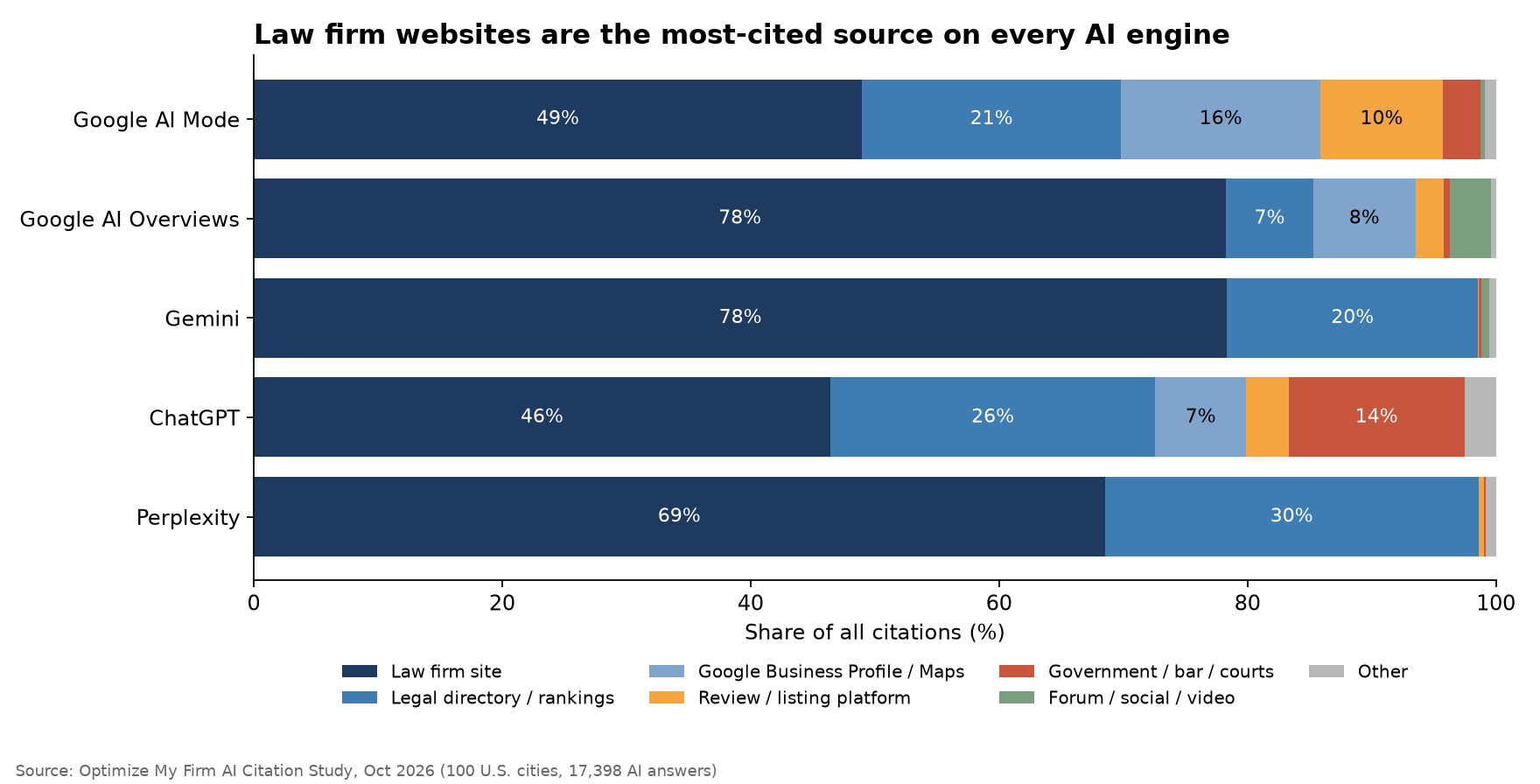
Across all five engines, the single largest source of citations is law firm websites. That contradicts the common claim that AI tools mostly skip firm sites in favor of directories.
The mix changes with the kind of search:
| Search type | Law firm sites | Legal directories | Google Business Profile / Maps | Government / bar / courts |
|---|---|---|---|---|
| Finder (“best PI lawyer in…”) | 41% | 42% | 10% | 1% |
| Case type (car, truck, dog bite…) | 76% | 17% | 4% | 0% |
| Conversational (“I was rear-ended…”) | 81% | 11% | 2% | 2% |
| Decision (“do I need a lawyer…”) | 67% | 15% | 0% | 13% |
Share of citations, all engines combined.
For broad “best lawyer” searches, directories carry as much weight as firm sites. For case-type and question searches, which is where practice-area pages and real explanatory content live, firm sites carry most of the citations.
ChatGPT stands out for citing government, bar, and court sites (14% of its citations, and 31% of its answers cite at least one). Most of those come from the decision-style questions.
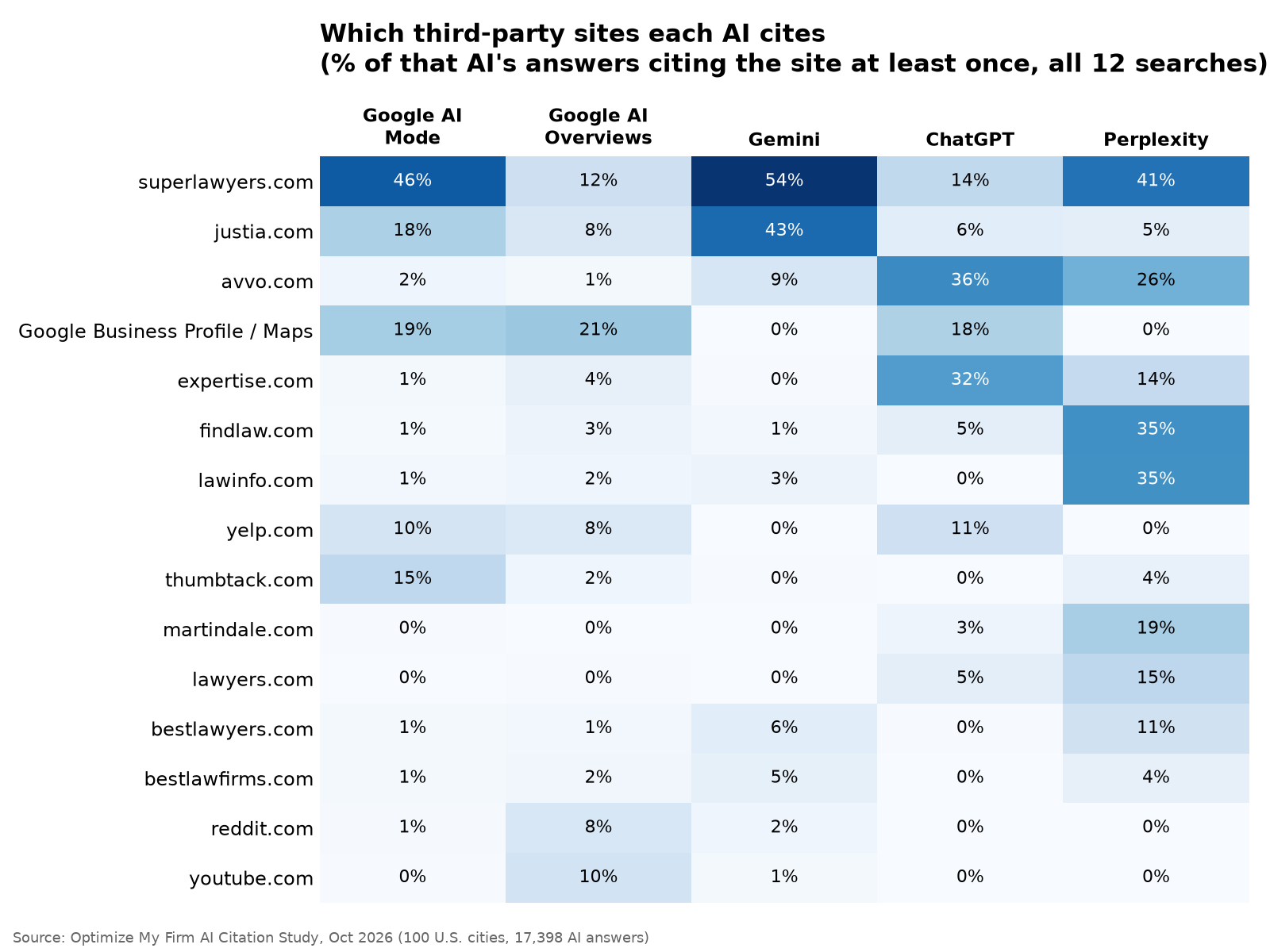
Each engine has a distinct set of favorite sources:
Super Lawyers is the most consistent directory, showing up in 63% of all “finder” answers. Avvo is close to absent in Google’s AI (1–2%) but is a top source for ChatGPT and Perplexity. That likely explains why other published studies disagree so much about Avvo: their results depend on which engine they tested.
ChatGPT cited Google Maps place listings in 18% of its answers, and Google’s own AI cited Google Business Profile listings in about 1 in 5 answers. For local searches, the Google Business Profile is a citation source on its own, separate from its role in the map pack.
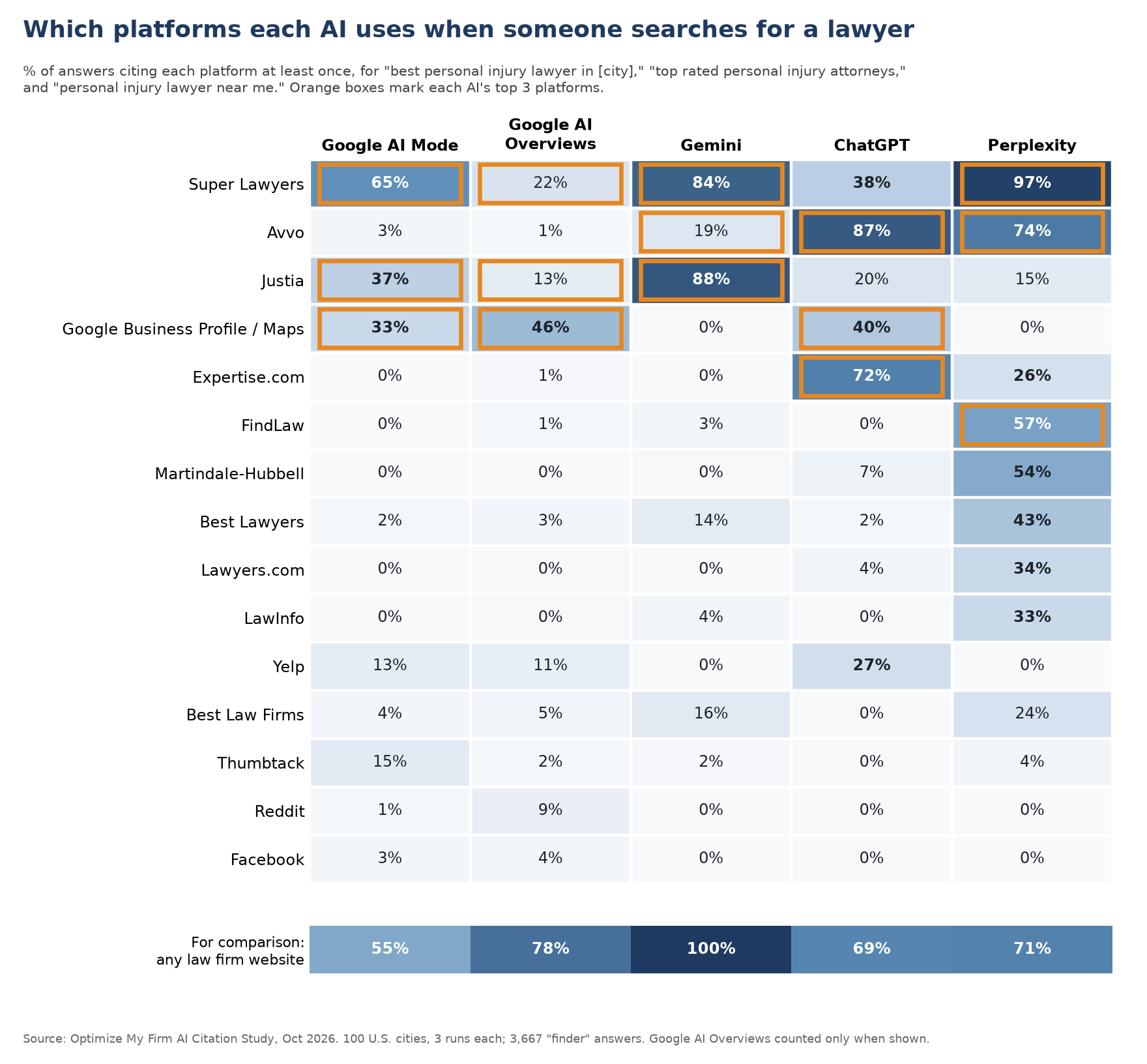
The source mix shifts when someone is looking for a lawyer rather than asking a question. On the three “finder” searches (“best personal injury lawyer in [city],” “top rated personal injury attorneys in [city],” and “personal injury lawyer near me”), third-party platforms make up most of the citations on every engine except Google AI Overviews and Gemini:
| Engine | Third-party platforms (directories, Google listings, review sites) | Law firm sites |
|---|---|---|
| Google AI Mode | 69% | 30% |
| Google AI Overviews | 35% | 62% |
| Gemini | 38% | 60% |
| ChatGPT | 60% | 31% |
| Perplexity | 78% | 20% |
Share of citations on finder searches.
Each engine’s top three platforms on these searches:
Yelp is a second-tier platform for lawyers, and it matters on some engines and searches but not others:
| Engine | Finder searches | “I was rear-ended…” | Case-type searches | Question searches |
|---|---|---|---|---|
| ChatGPT | 27% | 7% | 11% | 0% |
| Google AI Overviews | 11% | 32% | 2% | 3% |
| Google AI Mode | 13% | 17% | 9% | 1% |
| Gemini | 0% | 0% | 0% | 0% |
| Perplexity | 0% | 0% | 0% | 0% |
Share of answers citing Yelp.
ChatGPT’s reliance on Yelp is consistent with Yelp licensing its review data to OpenAI in July 2026 (Pavado). Yelp appears much less often for lawyers than for local businesses overall: BrightLocal found Yelp in 80% of ChatGPT local answers across all business types (BrightLocal).
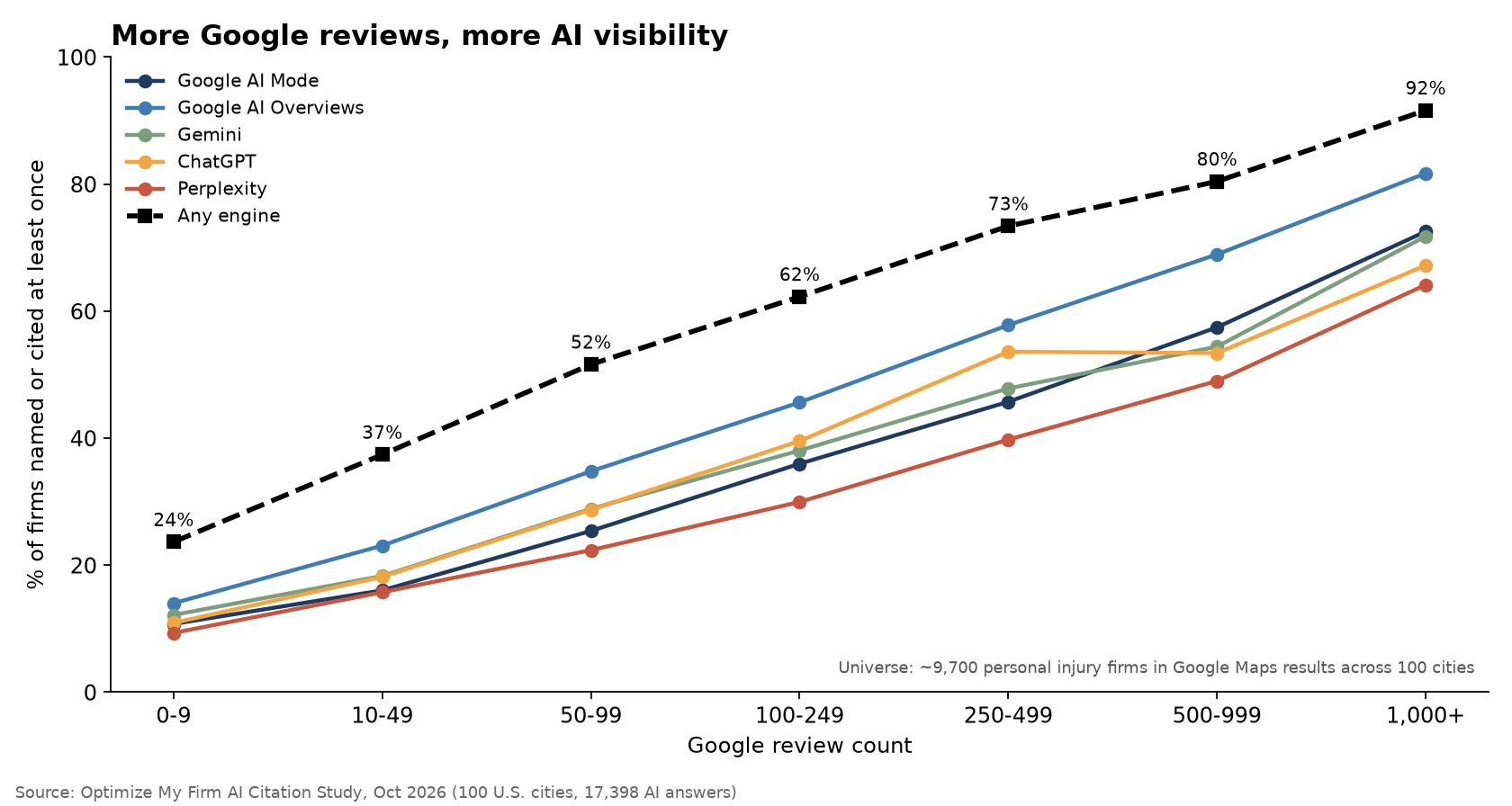
We took every firm that appeared in Google Maps results for “personal injury lawyer” in each city (9,753 listings, median of 27 reviews), then checked whether each AI engine named the firm or cited its website in any of that city’s answers.
| Google reviews | Firms | Named or cited by any engine | Avg. answers naming the firm |
|---|---|---|---|
| 0–9 | 3,037 | 24% | 2.8 |
| 10–49 | 3,052 | 37% | 4.3 |
| 50–99 | 1,320 | 52% | 7.7 |
| 100–249 | 1,346 | 62% | 11.5 |
| 250–499 | 571 | 73% | 16.9 |
| 500–999 | 296 | 80% | 21.7 |
| 1,000+ | 131 | 92% | 30.7 |
The relationship holds on every engine. Google AI Overviews shows the steepest climb (14% at 0–9 reviews, 82% at 1,000+).
Firms ranking in the top 3 of Google Maps for “personal injury lawyer” were named by AI 94% of the time. Firms ranked 50th or lower were named 30% of the time.
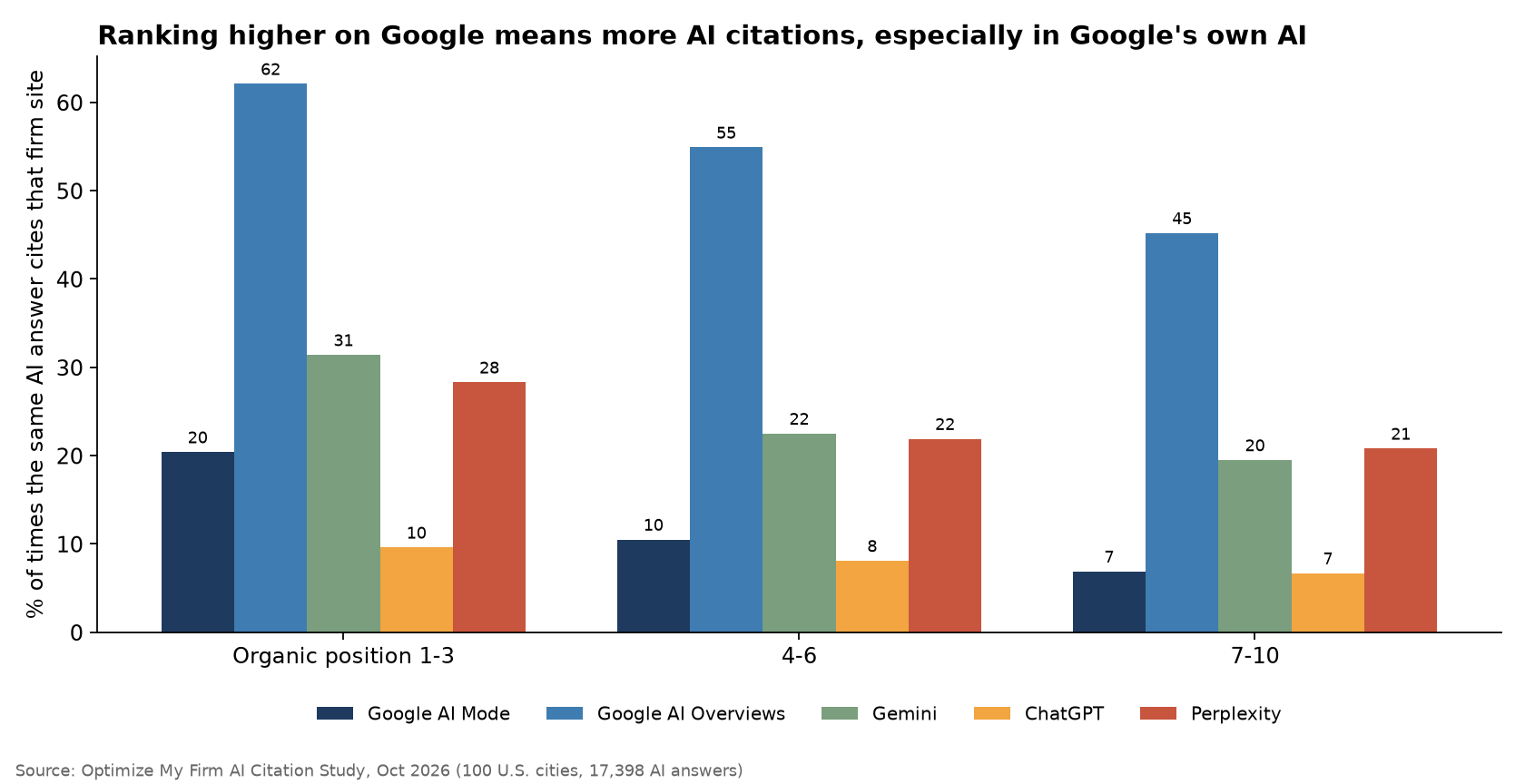
For every search, we compared each AI answer with Google’s organic top 10 for the same search, city, and run. When a law firm’s page ranked in positions 1–3, the AI answer on that same search cited the firm’s site:
Every engine cites top-3 firms more often than firms in positions 7–10.
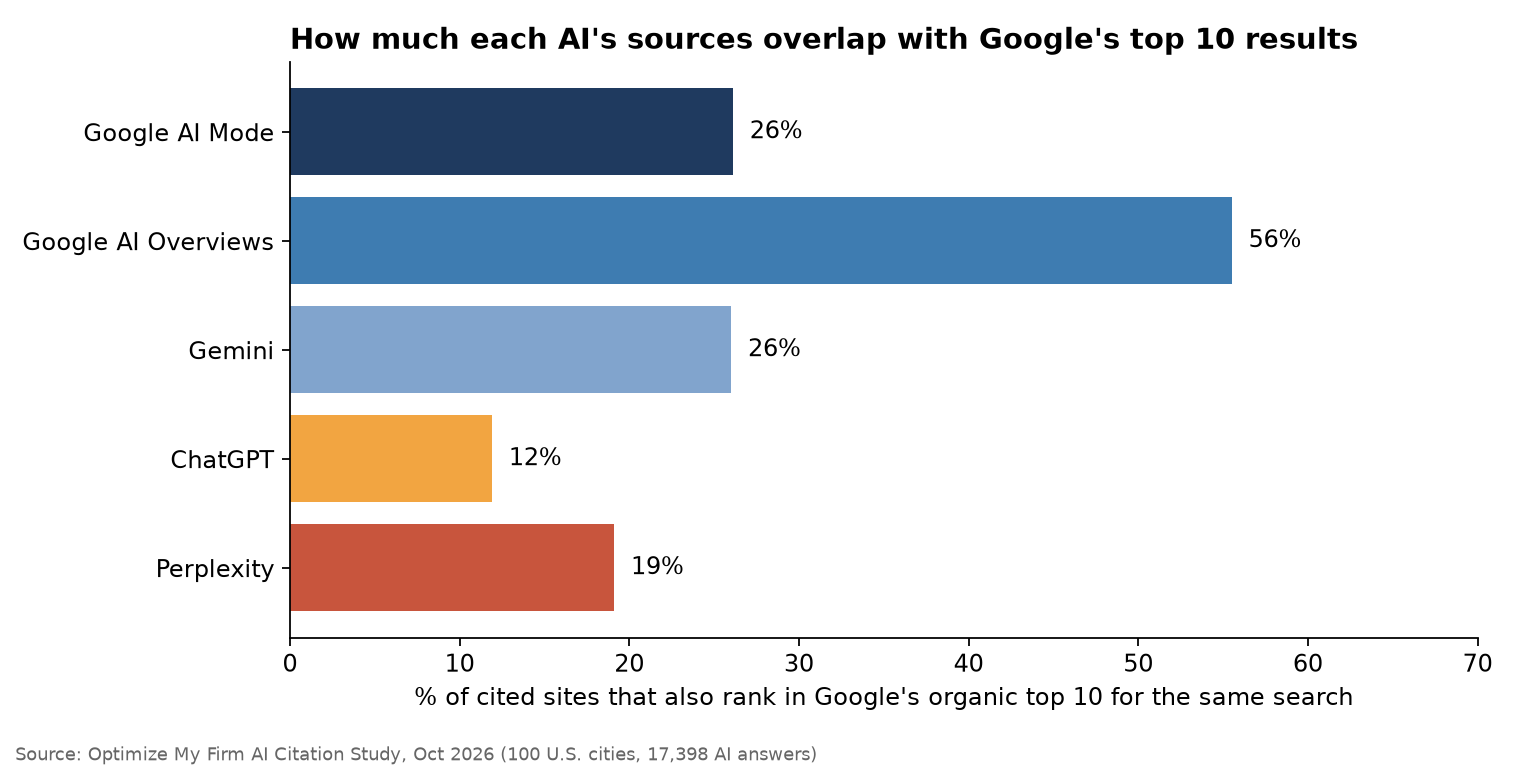
Google AI Overviews behaves most like a summary of the organic results: 56% of the sites it cites also rank in the top 10 for that search. ChatGPT is the most independent, at 12%.
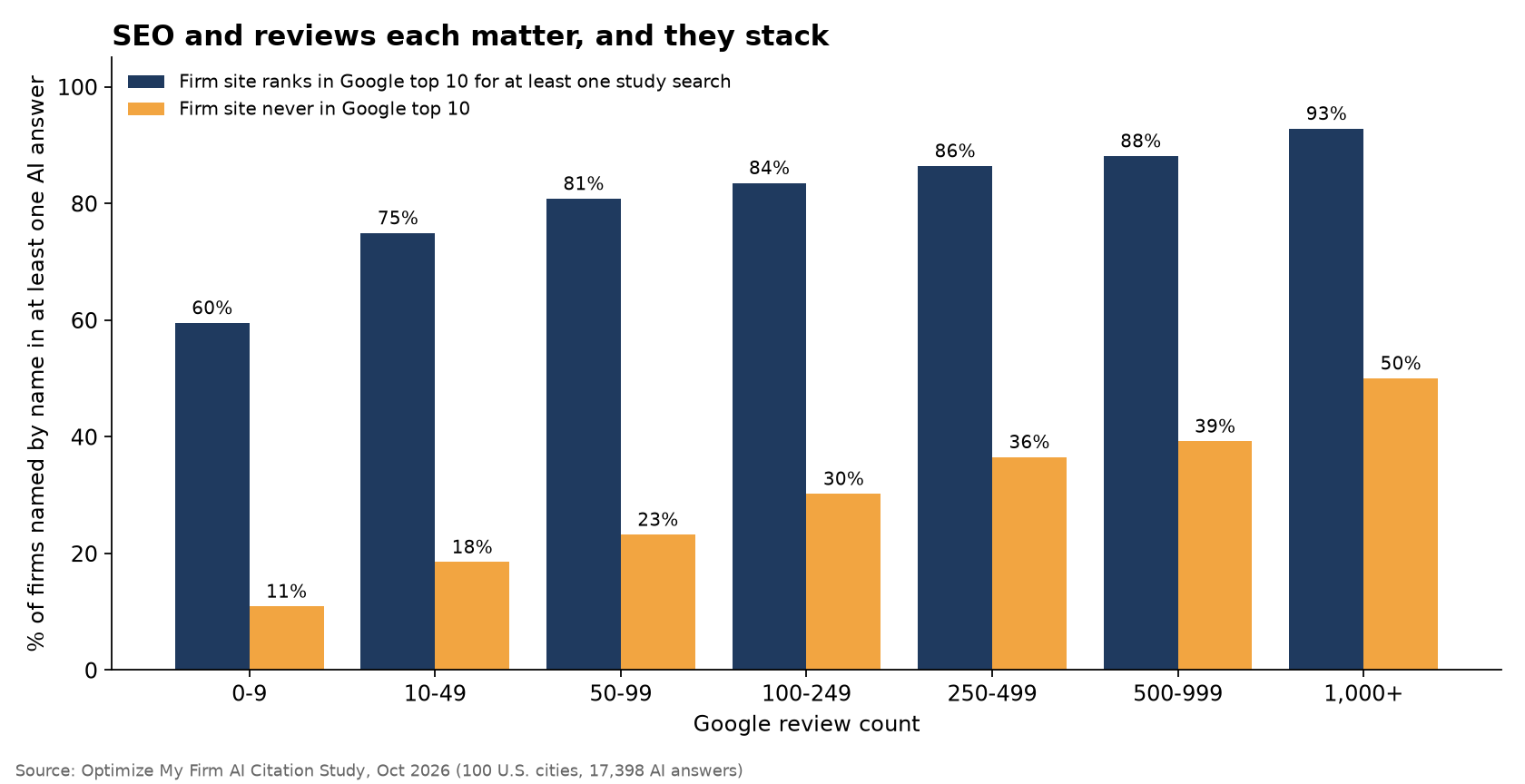
To separate SEO from reviews, we split firms by whether their site ranked in Google’s organic top 10 for any of that city’s study searches. The measure here is strict: the firm’s name has to appear in the answer text itself.
A logistic regression on the same 9,753 firms (outcome: named in at least one AI answer in their city) found:
| Factor | Effect on odds of being named |
|---|---|
| Firm site ranks in organic top 10 | About 11 times higher (odds ratio 10.8) |
| Doubling Google review count | About 19% higher |
| Better Google Maps rank (halving rank number) | About 37% higher |
| Each additional star of rating | About 19% higher |
All four factors were statistically significant (p < 0.01).
Ranking organically has the largest effect by far, and reviews add to it independently. A firm with strong SEO and few reviews does better than a firm with many reviews and no organic presence. The firms that show up most do both.
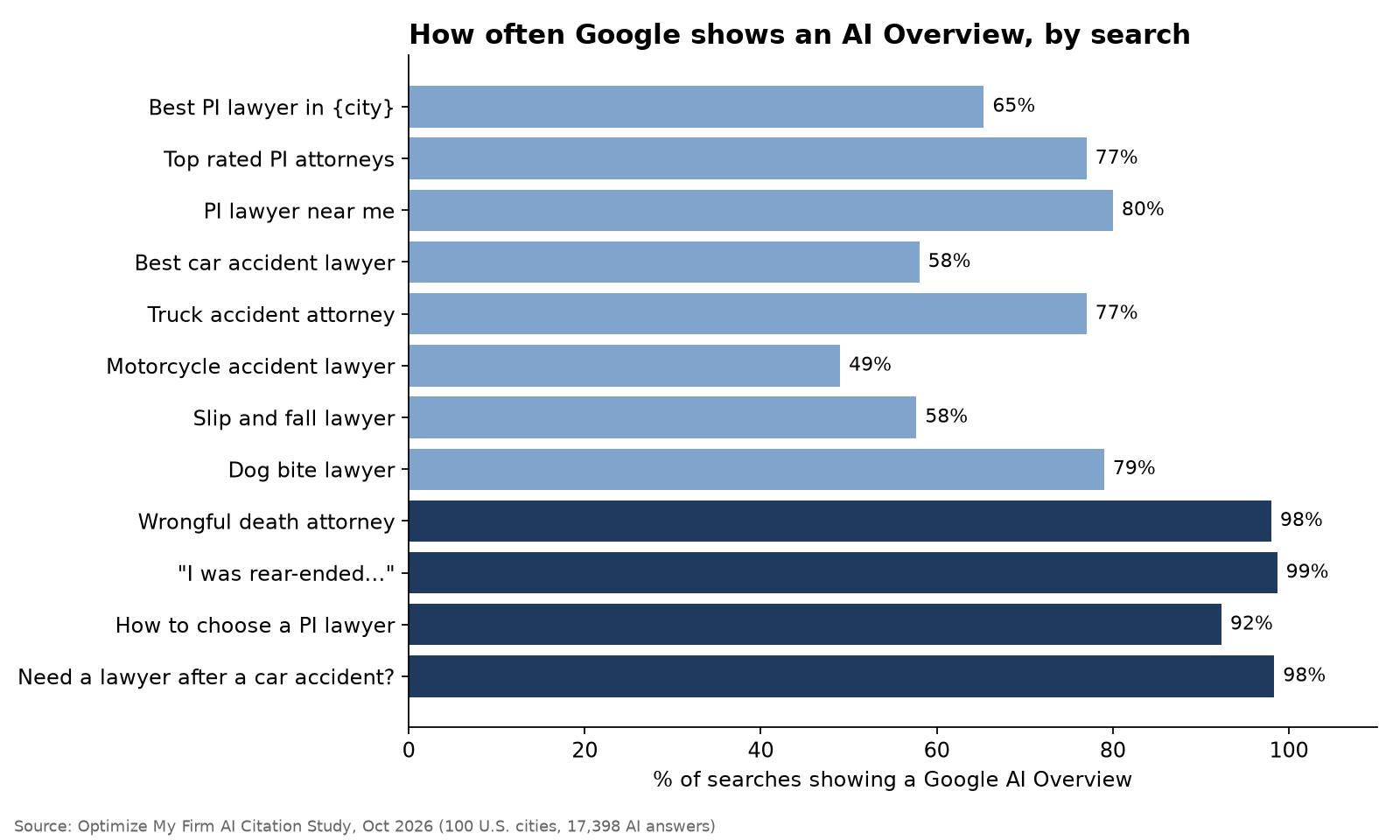
Google showed an AI Overview on 78% of study searches overall, but that varies widely by search:
For many “find me a lawyer” searches, Google still shows a regular results page with no AI summary. The map pack and organic rankings carry those searches entirely.
Each prompt ran three times. Overlap in cited sites between runs (Jaccard similarity) was:
Outside the Perplexity API, the same question can return a noticeably different set of sources from one run to the next. Single-run snapshots, which many vendor studies rely on, overstate how fixed these results are.
Published studies on this question often conflict:
Our data explains much of the disagreement. Avvo is near zero in Google’s AI and a top source in ChatGPT, so results depend on which engine a study tests. Directory share also roughly doubles on “finder” searches compared with case-type searches, so results depend on prompt wording too.
| Cities | 100 U.S. cities in 37 states plus D.C., chosen from a 124-city list of large U.S. cities after removing overlapping suburbs |
| Prompts | 13 personal injury searches: 1 local (“personal injury lawyer [city]”), 3 “finder,” 6 case-type, 1 conversational, 2 decision/question |
| Engines | Google AI Mode, Google AI Overviews, Gemini, ChatGPT, Perplexity |
| Runs | Each prompt × city × engine run 3 times |
| Answers | 18,898 AI answers. Findings 2–9 use the original 12 prompts (17,398 answers, 111,130 citations across 6,401 unique domains). |
| Google baseline | Organic top 10 and local pack for every prompt, city, and run |
| Reviews | Google Maps results for “personal injury lawyer” in each city: 9,753 firm listings with rating and review count. Yelp rating and review count and Avvo attorney reviews for each firm, from Google results for the firm name plus “Yelp” or “Avvo” (9,633 firms matched). |
| Data source | DataForSEO APIs. Gemini and ChatGPT answers were captured as they appear in each app, with sources. Perplexity answers came from its sonar-pro API with web search. Google results were set to each city’s location. |
Prompt list:
| # | Intent | Prompt |
|---|---|---|
| 1 | Finder | best personal injury lawyer in {city}, {ST} |
| 2 | Finder | top rated personal injury attorneys in {city} |
| 3 | Finder | personal injury lawyer near me (location set to the city) |
| 4 | Case type | best car accident lawyer in {city} |
| 5 | Case type | truck accident attorney in {city} |
| 6 | Case type | motorcycle accident lawyer in {city} |
| 7 | Case type | slip and fall lawyer in {city} |
| 8 | Case type | dog bite lawyer in {city} |
| 9 | Case type | wrongful death attorney in {city} |
| 10 | Conversational | I was rear-ended in {city}. Who should I call for a lawyer? |
| 11 | Decision | how do I choose a personal injury lawyer in {city}? |
| 12 | Decision | do I need a lawyer after a car accident in {state}? |
| 13 | Local | personal injury lawyer {city} |
The full study, including every chart and table on this page, is available as a PDF. Questions about the methodology or data: contact us.
Optimize My Firm helps personal injury firms earn visibility in Google and AI search with strong SEO, real backlinks, and unique content.