
We described 50 real-world injury situations to five AI platforms, 4,500 times, to see what they tell injured people to do: call a lawyer, call the insurer, see a doctor, or handle it themselves.
Optimize My Firm | 4,500 AI answers | 50 injury scenarios | 6 states | ChatGPT, Gemini, Google AI Mode, Perplexity and Claude | October 2026
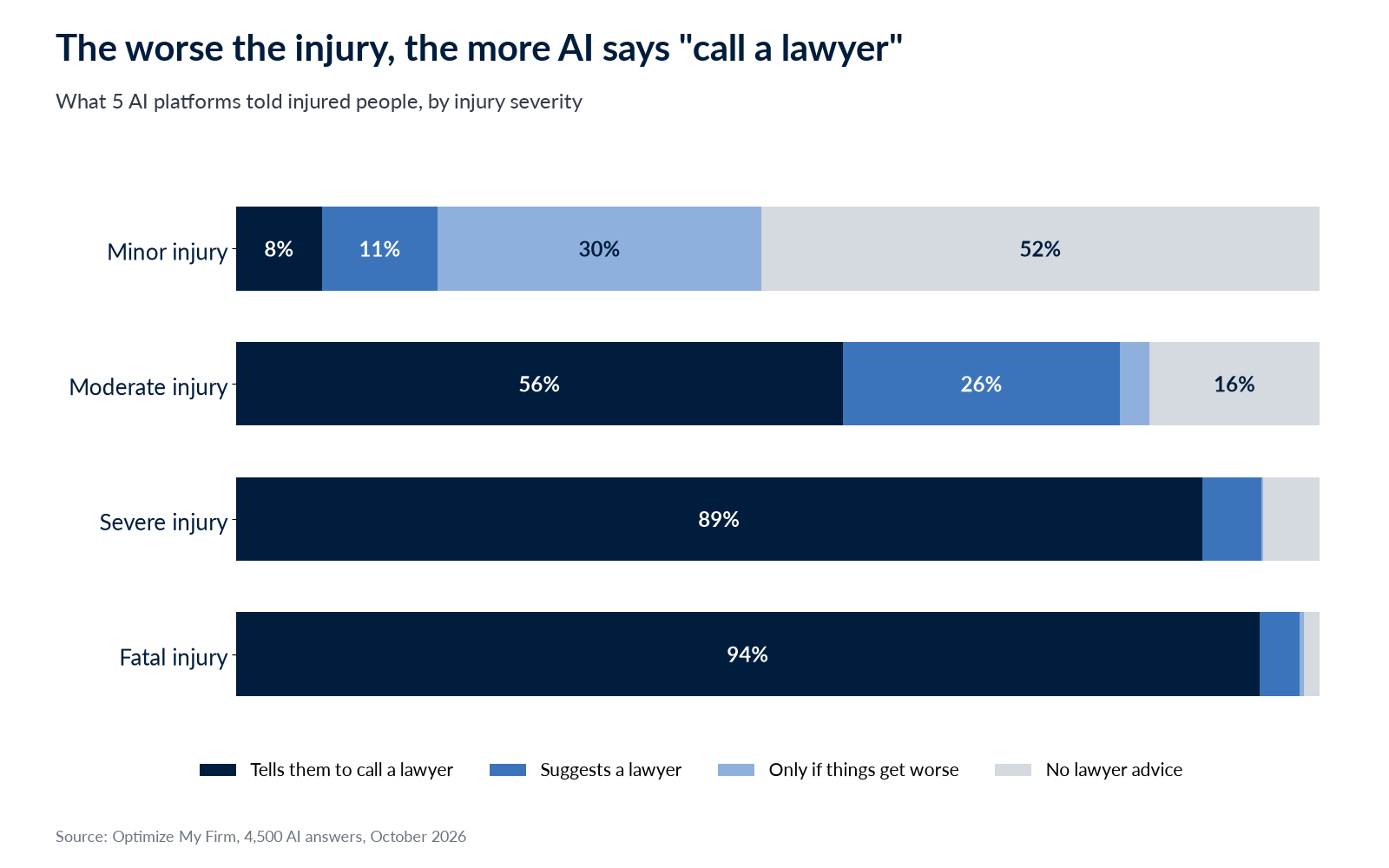
Each situation was written at different levels of injury, from a dented bumper to a death in the family. The worse the injury, the more direct the advice. For minor injuries, most of the lawyer advice was conditional: “if your pain gets worse or the insurer pushes back, consider talking to a lawyer.”
| Injury severity | Answers | Tells them to call a lawyer | Suggests a lawyer | Only if things get worse | No lawyer advice |
|---|---|---|---|---|---|
| Minor | 1,440 | 8% | 11% | 30% | 52% |
| Moderate | 1,620 | 56% | 26% | 3% | 16% |
| Severe | 1,170 | 89% | 5% | 0% | 5% |
| Fatal | 270 | 94% | 4% | 0% | 1% |
“No lawyer advice” includes answers that never mention a lawyer, answers that list a lawyer as an option without recommending one, and a handful (8 of 4,500) that said a lawyer probably isn’t needed.
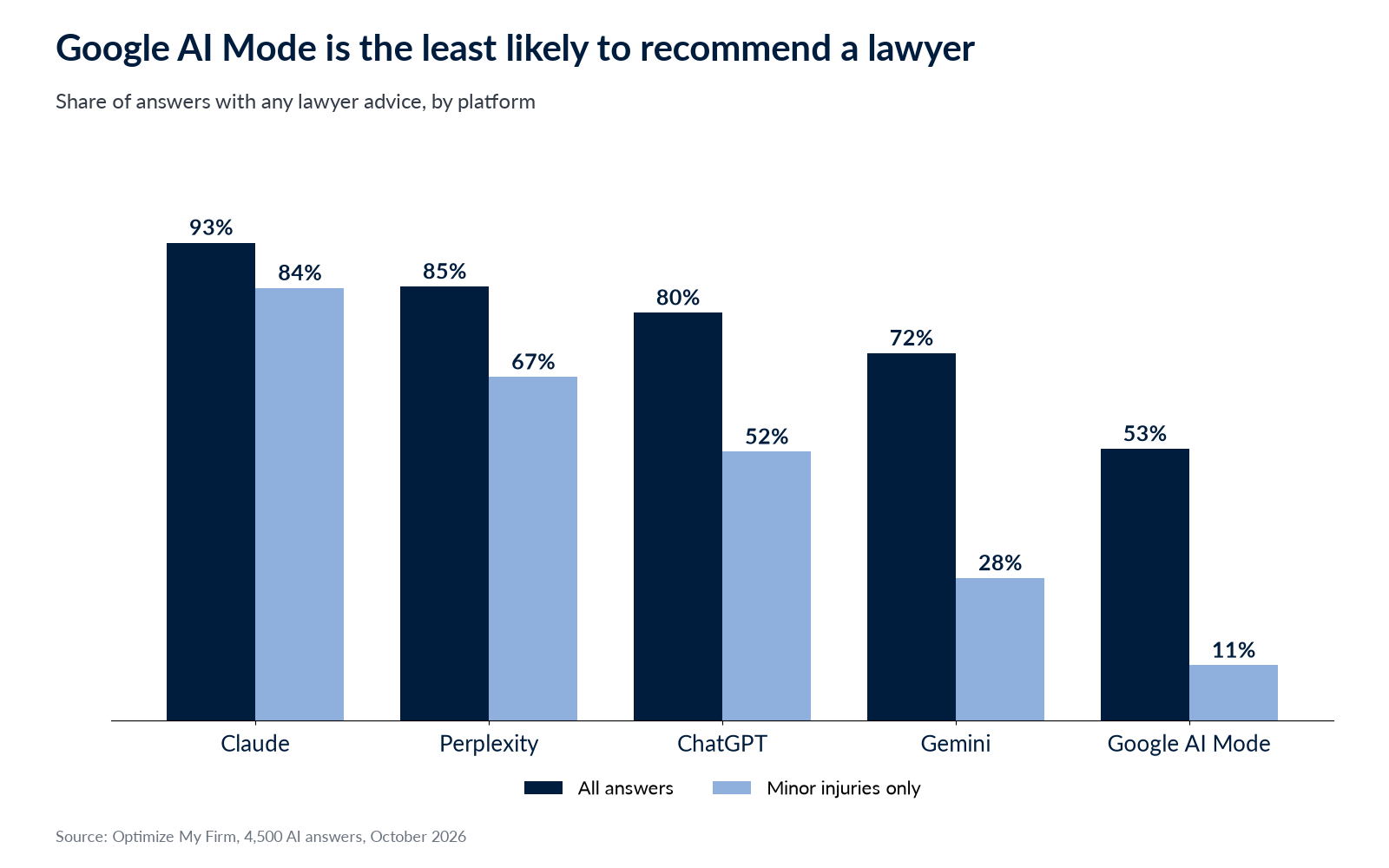
The five platforms gave very different advice for the same situation. Google AI Mode is the only one that skipped lawyer advice in a large share of moderate injuries, and it and Gemini were the most likely to tell people to let the insurance company handle it.
| Platform | Minor | Moderate | Severe | Fatal |
|---|---|---|---|---|
| Claude | 16% | 1% | 5% | 0% |
| Perplexity | 33% | 11% | 3% | 0% |
| ChatGPT | 48% | 9% | 8% | 0% |
| Gemini | 72% | 13% | 2% | 0% |
| Google AI Mode | 89% | 44% | 9% | 7% |
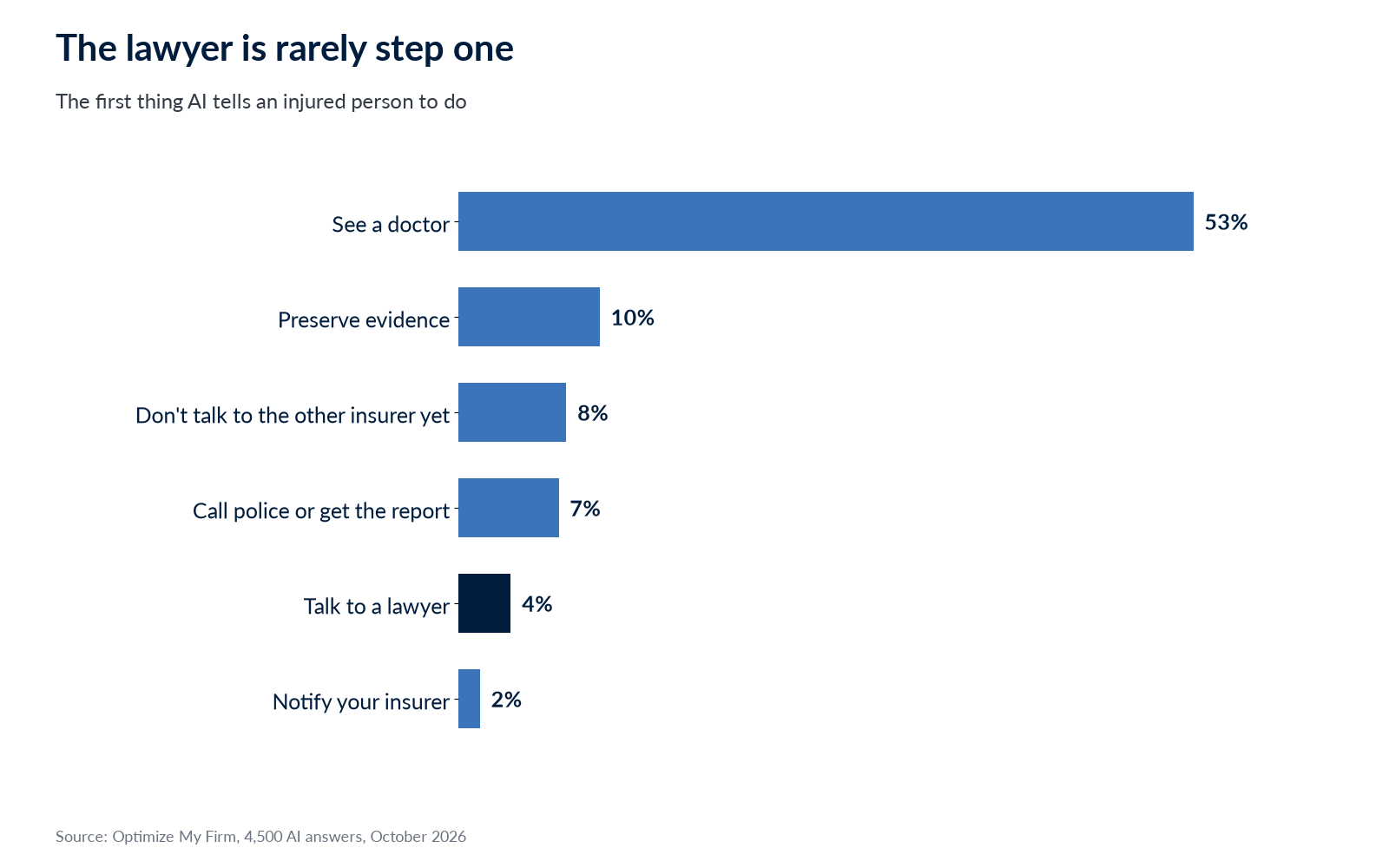
Most answers were a numbered list of steps. Medical care almost always came first, and that is good advice. The lawyer usually appeared near the end: in the first step of 7% of answers, in steps two or three of 19%, and later in the list in 40%. 21% of answers didn’t mention a lawyer at all.
Some answers told the person to let the insurer take it from there. Gemini did this 99 times and Google AI Mode 94 times, compared with 40 for Claude, 8 for Perplexity and 3 for ChatGPT. Another 256 answers told the person to negotiate the claim themselves.
Some situations got far less lawyer advice than others, even when a lawyer could help.
| Situation | Severity | Any lawyer advice |
|---|---|---|
| Parked car hit, driver left | Minor | 7% |
| Mom had a minor fall in a nursing home, bruised arm | Minor | 9% |
| Neighbor’s dog nipped my hand | Minor | 18% |
| Space heater sparked, no one hurt | Minor | 19% |
| Headaches and neck pain started four days after a crash | Moderate | 24% |
| Rear-ended, bumper damage only | Minor | 26% |
| $600 offer for a sore neck | Minor | 46% |
| Severe burns from a pressure cooker | Severe | 50% |
| E-bike battery fire, burned hand | Moderate | 54% |
| Other driver’s insurer accepted fault on day three | Moderate | 72% |
| Slipped in a grocery store, bruised | Minor | 76% |
| Motorcycle crash with road rash | Minor | 81% |
| Car repair claim denied, insurer says I was partly at fault | Minor | 92% |
We asked every question twice, word for word, on the same night. One in four times, the lawyer advice changed. Most changes were small, like “contact a lawyer” turning into “consider a lawyer.” But Gemini and Google AI Mode flipped between recommending a lawyer and not mentioning one in about 1 of every 6 repeats.
| Platform | Same lawyer advice both times | Flipped between lawyer advice and none |
|---|---|---|
| ChatGPT | 83% | 7% |
| Perplexity | 81% | 7% |
| Claude | 75% | 5% |
| Google AI Mode | 72% | 17% |
| Gemini | 65% | 16% |
| All platforms | 75% | 10% |
This matches SparkToro’s research showing that AI recommendations change a lot from one run to the next.
| Advice | All | ChatGPT | Gemini | AI Mode | Perplexity | Claude |
|---|---|---|---|---|---|---|
| See a doctor | 79% | 81% | 78% | 76% | 83% | 79% |
| Take photos | 75% | 79% | 59% | 61% | 86% | 92% |
| Get the police report | 72% | 74% | 64% | 66% | 77% | 78% |
| Be careful with a recorded statement | 59% | 48% | 51% | 48% | 74% | 76% |
| Mentions a deadline | 56% | 60% | 46% | 40% | 48% | 86% |
| Don’t sign a release | 46% | 70% | 25% | 24% | 70% | 43% |
| Lawyers often offer a free consultation | 38% | 30% | 48% | 13% | 7% | 90% |
| Explains contingency fees | 31% | 30% | 34% | 5% | 8% | 76% |
| The first offer is often low | 12% | 3% | 13% | 11% | 1% | 30% |
| Keep a symptom journal | 12% | 3% | 15% | 11% | 6% | 25% |
| Stay off social media | 11% | 7% | 4% | 2% | 12% | 30% |
| State bar lawyer referral service | 7% | 15% | 0% | 5% | 1% | 15% |
Claude did the most to explain how hiring a lawyer works, including free consultations, contingency fees and deadlines. Google AI Mode almost never explained what a lawyer costs. ChatGPT and Perplexity were the most likely to warn people not to sign a release.
The answers cited 16,076 sources. 57% were law firm websites, 20% were government sites, 6% were legal directories and publishers, 5% were medical sites and 2% were bar associations.
| Platform | Sources cited | Law firm share | Answers citing at least one law firm |
|---|---|---|---|
| Perplexity | 7,795 | 63% | 93% |
| Google AI Mode | 3,088 | 68% | 90% |
| ChatGPT | 2,597 | 5% | 10% |
| Gemini | 1,734 | 79% | 49% |
| Claude | 862 | 81% | 21% |
Our questions described what happened. None of them asked “who should I call?” Earlier industry tests found AI names firms far more often when someone asks for one: Citorian reported 18% vs. 94%, and Herringbone reported 18% vs. 92%. Our results fit that pattern. AI tells people to get a lawyer, then leaves the choosing to their next search.
We ran every scenario in Florida, New York, Pennsylvania, North Carolina, Texas and California. Two rules matter a lot to injured people in those states, and some platforms rarely mentioned them.
| Rule | Claude | Gemini | AI Mode | ChatGPT | Perplexity |
|---|---|---|---|---|---|
| Pennsylvania limited vs. full tort (75 Pa.C.S. § 1705), share of PA answers | 36% | 23% | 13% | 3% | 3% |
| North Carolina contributory negligence (UNC School of Government), share of NC answers | 83% | 63% | 63% | 23% | 6% |
When answers did state a rule, they were usually right. Of 20 answers that mentioned Florida’s old four-year deadline, 19 correctly said it had been cut to two years (Fla. Stat. § 95.11). No answer called North Carolina a comparative-fault state, and no answer said California bars recovery when the injured person is partly at fault (Li v. Yellow Cab).
The bigger problem is what gets left out. In North Carolina, being even slightly at fault can bar recovery, yet ChatGPT mentioned this in 23% of NC answers and Perplexity in 6%.
AI is doing part of intake for the legal industry. For serious injuries, it sends people to a lawyer almost every time. For everything else, it often tells them to see a doctor, deal with the insurer, and come back if things get worse. Those are the cases where a firm can still help, and where people most need to hear that early.
We wrote 50 scenarios in the plain language an injured person would use, covering car, truck, motorcycle, pedestrian, rideshare and bus crashes, hit-and-runs, slip and falls, dog bites, insurer problems, nursing homes and defective products. 16 were minor, 18 moderate, 13 severe and 3 fatal. Every scenario was set days to a couple of weeks after the incident, when most people start looking for help. Each one named one of six states: Florida, New York, Pennsylvania, North Carolina, Texas or California.
Each scenario ran three times in each state on each platform: the same wording twice to measure run-to-run variation, and a reworded version once. That is 50 scenarios × 6 states × 3 runs × 5 platforms = 4,500 answers. All answers were collected on the evening of October 26, 2026 (Eastern), between 03:54 and 04:25 UTC on October 27, through the DataForSEO API.
ChatGPT (gpt-6 with web search), Gemini (3.5 Flash-Lite), Perplexity (sonar-pro), Claude (claude-sonnet-5-5, with web search available) and Google AI Mode results. Except for Google AI Mode, these are the API versions of each platform, not the apps people sign into, and they have no location, account history or memory. Claude chose to search the web in only 21% of its answers.
An AI coder (Claude Sonnet) applied fixed written rules to every answer. Lawyer advice was coded at the strongest level in the answer: tells them to call a lawyer (“contact a personal injury attorney”), suggests a lawyer (“consider talking to a lawyer”), only if something happens (“if your pain gets worse, talk to a lawyer”), mentioned without advice, not mentioned, or discourages. Disclaimers such as “this isn’t legal advice” were ignored. Checklist items such as recorded statements and releases were found by text matching, and every cited source was classified by type.
A human reviewer hand-coded a stratified sample of 450 answers (10%) and agreed with the AI coder on 435 (97%). In 13 of the 15 disagreements, the AI coder rated the advice one level stronger than the reviewer did, so the share of “tells them to call a lawyer” answers may run about 3 points high.
Download the coded dataset (Excel): all 50 scenarios with their prompts, and one row per answer with every code and cited domain.
Optimize My Firm helps personal injury firms grow with strong SEO, real backlinks, and original content, including unique photos and real perspective that most agencies skip.